 EN
 English
 中文简体
Home / News / Industry News / Insecticide Formulation Explained: 45% Bifenazate·Etoxazole SC Use, Benefits, and Application Guide
Industry News
Content
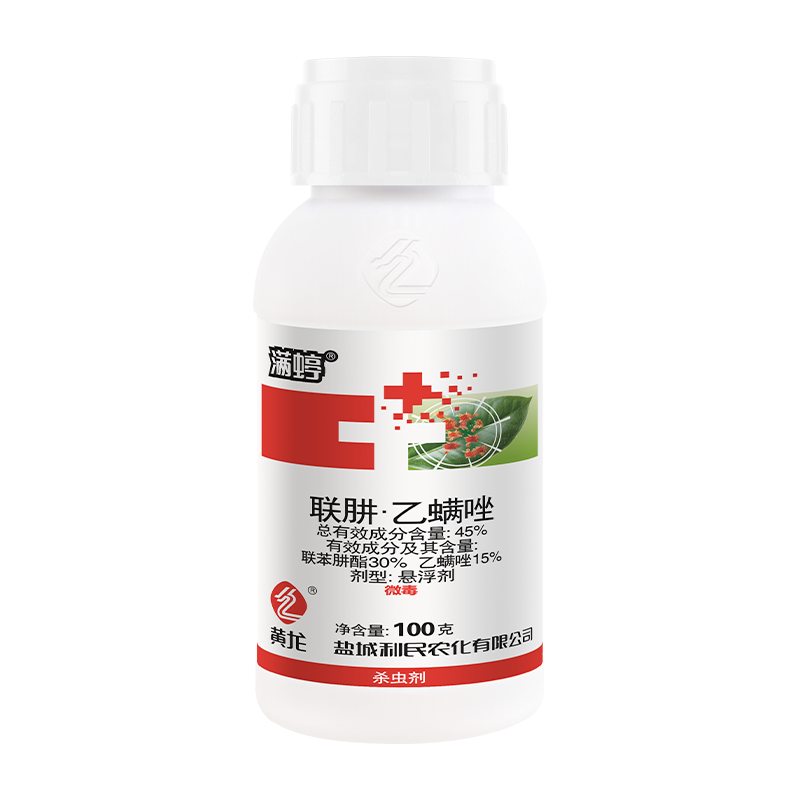
A 45% bifenazate and etoxazole suspension concentrate is a water based formulation that delivers two miticides with different modes of action in one spray, controlling spider mites across all of their key life stages while helping growers slow the development of resistance. Bifenazate targets adult and nymphal mites, while etoxazole acts on eggs and immature stages, so the combination covers the population in a single application.
For growers, distributors, and crop advisors comparing options, the practical conclusion is simple. An SC formulation of this combination makes sense when you need a low odor, non flammable product that mixes readily with water, stays physically stable in the tank, and fits into a rotation program that avoids repeated use of the same chemical class. The formulation itself is what turns two good active ingredients into a usable product, and the rest of this guide explains how to get the most from it.
45 percent combined by weight or volume
Water with dispersed solid particles
Spider mites and related mite species
Two modes of action in one product
An insecticide formulation is the finished product as sold, combining active ingredients with carriers, surfactants, dispersants, wetting agents, antifoam agents, thickeners, and preservatives that control how the material is stored, mixed, sprayed, and taken up by the pest or the plant surface. Two products built from identical active ingredients can behave very differently in the field depending on how the formulation handles particle size, dispersion, and surface spreading.
Dispersants keep the solid active particles separated so they do not clump in the bottle or the tank. Wetting agents lower surface tension so droplets spread across waxy leaf surfaces rather than beading up and rolling off. Thickeners prevent settling during storage, and antifoam agents reduce foam formation during agitation. A well built suspension concentrate typically maintains a stable suspension for two years or more under normal storage conditions between 0 and 35 degrees Celsius.
Spider mites often colonize the underside of leaves, where coverage is harder to achieve than on the upper surface. A formulation that disperses evenly and spreads well gives better deposition on those hidden surfaces. Because the carrier is water rather than an organic solvent, the product also reduces the solvent odor and flammability concerns that come with some older emulsifiable concentrate products.
| Formulation | Carrier | Odor and Flammability | Typical Storage Life |
|---|---|---|---|
| Emulsifiable Concentrate (EC) | Organic solvent | Strong odor, flammable | 2 to 3 years |
| Suspension Concentrate (SC) | Water | Low odor, non flammable | 2 years or more |
| Wettable Powder (WP) | Solid inert filler | Dust risk during mixing | 2 to 3 years |
The two active ingredients in this product belong to different chemical families and act on different biological processes, which is the foundation of the combination. Understanding each one separately explains why the pairing works and why timing matters.
Bifenazate is a carbazate acaricide. It interferes with mitochondrial energy production in mites, which is why it is classified in IRAC mode of action group 20B. It acts mainly on adult and nymphal stages and produces a relatively quick knockdown of active populations, which helps growers see results within a few days of application. Its activity on eggs is limited, so it is typically used alongside a product that targets eggs.
Etoxazole is a mite growth inhibitor that disrupts chitin formation during molting. It is listed in IRAC mode of action group 10B. It is most active against eggs and developing immature stages, and it prevents those stages from completing their development into reproductive adults. Because etoxazole does not kill adults directly, its value comes from breaking the reproductive cycle and suppressing the next generation.
| Characteristic | Bifenazate | Etoxazole |
|---|---|---|
| Chemical class | Carbazate | Diphenyl oxazoline |
| IRAC mode of action group | 20B | 10B |
| Main life stages affected | Adults and nymphs | Eggs and immature stages |
| Speed of visible effect | Relatively fast knockdown | Slower, suppresses next generation |
A single active ingredient applied repeatedly exerts strong selection pressure on mite populations, and resistance can build within a few seasons when the same mode of action is relied on alone. Combining two groups with different targets reduces that pressure and gives a broader control window.
Spider mite populations in a single block are rarely uniform. A typical infestation includes eggs, several immature stages, and adults at the same time. Bifenazate reduces the active mobile population quickly, while etoxazole lowers the number of eggs that hatch and the immatures that would otherwise mature. The result is a more complete reduction across the population than either active could deliver alone.
Resistance management depends on alternating or combining modes of action so that no surviving individual faces the same chemical pressure every time. Because the two actives come from different IRAC groups, the product itself carries a built in rotation element. Growers should still avoid using the combination in consecutive sprays beyond the label limit, because even two good modes of action can lose effectiveness if they are overused.
Fewer passes through the orchard or field lower fuel, labor, and equipment costs, and they reduce the number of times workers enter treated areas. A program that controls mites with a combined product in one well timed spray can replace two separate applications, which is a practical gain in both cost and safety.
Spider mites in the genus Tetranychus and Panonychus are the principal targets, and the crops where they cause the most economic damage include fruit trees, berries, vegetables, ornamentals, and field crops. Registered crops and pest lists vary by country and by label, so the registered label always defines the permitted use.
The twospotted spider mite, Tetranychus urticae, is one of the most widespread pests in greenhouse and field production because it reproduces quickly and develops resistance to many chemicals. European red mite, Panonychus ulmi, and citrus red mite, Panonychus citri, cause bronzing and leaf drop in orchards. Their populations can double within a week under warm, dry conditions, which is why early detection matters.
Strawberries, tomatoes, cucumbers, peppers, citrus, apples, pears, grapes, and ornamental nursery stock are frequent hosts. Hot, dry periods combined with dusty field edges accelerate outbreaks, and greenhouses without good ventilation often see faster population growth than open fields.
The label is the legal document that sets crops, pests, dose rates, spray volumes, pre harvest intervals, reentry periods, and maximum number of applications, so every decision should start there. The technical data sheet adds the quality data that explains how the product will behave in the tank.
The label lists the total active content, the individual active ingredient levels, the formulation code, the registration number, the crops and pests covered, the recommended dose per hectare or per unit area, the spray volume, the pre harvest interval, the reentry period, and any restrictions on use or number of applications per season. Reading the full label before purchase prevents costly mistakes such as applying to an unregistered crop.
Suspensibility, particle size distribution, pH of a dilute dispersion, foaming behavior, and accelerated storage stability all indicate how well the product will perform after storage and mixing. Quality suspension concentrates typically show suspensibility above 80 percent under standard testing, with particle sizes kept small enough to avoid nozzle blockage.
| Parameter | Typical Target | Practical Meaning |
|---|---|---|
| Total active content | 45 percent combined | Confirms dose calculations |
| Suspensibility | Above 80 percent | Indicates stable dispersion in the tank |
| pH of 1 percent dispersion | Mildly acidic to neutral range | Limits breakdown in mixed tanks |
| Storage stability | No significant change after 2 years | Protects value across seasons |
Most poor results with suspension concentrates trace back to the mixing sequence and to insufficient agitation rather than to the chemistry itself. Following a consistent procedure protects both efficacy and equipment.
Before mixing a new tank combination, a jar test with the same water source and the same proportions shows whether the products remain dispersed, form sludge, or separate into layers. Clean water is important here, because high calcium or magnesium levels can reduce suspension stability in some formulations. A jar test takes about 15 minutes and can prevent a full tank of wasted product and clogged nozzles.
Use clean, neutral water where possible. Very cold water slows dispersion, while very hot water can accelerate physical changes in some suspensions. Avoid mixing when water is near freezing, and never leave a mixed tank standing without agitation for extended periods.
Timing applications to mite population thresholds gives better results than spraying on a fixed calendar, because spraying too early wastes product and spraying too late allows populations to establish.
Weekly scouting is the standard practice during warm periods. Inspect a representative sample of leaves from several locations in the block, usually checking the underside of leaves with a hand lens and counting mites per leaf. Local extension services or advisory bodies publish action thresholds for each crop, and those thresholds should guide the decision to spray. Recording counts over time shows whether populations are rising, stable, or falling after treatment.
Spray volume depends on canopy density, equipment type, and label instructions. Dense orchards and tall greenhouse crops usually need higher volumes to reach the underside of leaves. Medium droplets in the range of 200 to 400 micrometers balance coverage and drift for most orchard and row crop sprayers. Water sensitive paper placed at mid canopy and on the lower leaf surfaces shows whether the spray is getting to the places where mites live.
Spray in calm conditions with wind speeds below about 10 kilometers per hour to limit drift. Avoid applying during intense midday heat, because rapid evaporation can reduce deposit uptake. Late afternoon or early morning applications often give more even coverage, provided leaves are dry before rain or heavy dew arrives.
Spider mites have one of the fastest resistance histories of any crop pest, so a long term program should combine rotation, label limits, and monitoring rather than relying on any single product.
Rotate the combined product with miticides from different IRAC groups rather than repeating the same group in consecutive sprays. Many programs use one application of this combination, followed by a product from another group if populations persist. Always check the current IRAC classification list, because group assignments can be updated as new information emerges.
Labels set the maximum number of applications per season and the minimum interval between them. Exceeding those limits accelerates resistance and may breach regulatory rules. Keeping a spray record that lists product, date, block, rate, and target pest makes it easy to prove compliance and to analyze efficacy later.
If mite counts fail to fall within about one week of a correctly applied spray, suspect either coverage problems or emerging resistance. Compare the result with other blocks that were treated under similar conditions, and consider a lab bioassay if the problem persists. Early detection gives more options than discovering resistance after an entire season has been lost.
Protecting applicators, bystanders, water sources, and the harvested crop depends on following the label precisely, using appropriate protective equipment, and storing the product correctly.
Chemical resistant gloves, long sleeved coveralls, eye protection, and a suitable respirator in enclosed spaces are the core items most labels require during mixing and spraying. Washing hands and face after work, and laundering contaminated clothing separately from household items, reduces exposure.
Store the product in its original sealed container, upright, in a locked dry area between 0 and 35 degrees Celsius, away from food, feed, seed, and direct sunlight. Frozen suspensions can aggregate irreversibly, so protect stock from frost during winter transport and storage. Keep containers closed when not in use and check for leaks each season.
The pre harvest interval is the minimum number of days between the final application and harvest, and it keeps residues within maximum residue limits in destination markets. The reentry period is the time workers must wait before entering treated areas without protective equipment. Both values are crop specific and must be taken from the registered label for the country where the crop is sold.
Keep spray drift away from water bodies and buffer zones defined by local regulations. Triple rinse empty containers, add the rinsate to the spray tank, and dispose of containers through approved collection programs.
The best miticide choice depends on the target stage, the crop, the resistance history of the block, and the safety profile required, so no single option wins in every situation.
Because etoxazole is slower acting against visible populations, growers with heavy infestations may need an additional knockdown product. Suspension concentrates also require disciplined agitation and careful storage. Growers in very cold regions should plan winter storage and transport in advance.
| Approach | Strength | Limitation |
|---|---|---|
| Combined bifenazate and etoxazole SC | Covers adults, nymphs, and eggs in one spray | Slower suppression of heavy visible populations |
| Single active knockdown product | Fast visible results | Higher resistance risk if used repeatedly |
| Biological predatory mites | Sustainable and resistance free | Needs warm conditions and careful timing |
Most complaints about this type of product come from mixing errors, poor coverage, or mistimed sprays rather than from inherent weakness in the formulation.
Sediment usually points to insufficient agitation, very hard water, or adding the product before the tank contains enough water. Pre dispersing the measured dose in a bucket of water, pouring it slowly into a moving tank, and filtering the spray solution through the correct mesh size restores uniform flow.
Weak results often reflect late timing when populations were already high, poor underside coverage, or spraying during hot dry weather that reduced deposit uptake. Compare counts before and after treatment, check spray deposits, and review the application history before blaming the product.
Leaf injury can occur when the product is tank mixed with incompatible materials, applied during extreme heat, or applied at rates above the label. A small test area on a few plants before large scale use reduces this risk and gives a clear answer before the whole block is treated.
When populations keep returning despite correct application, the likely causes are resistance, reinfestation from neighboring blocks, or dust and drought conditions that favor mites. Working with an agronomist to review the full program is more productive than changing products repeatedly.
Question: What does 45 percent bifenazate etoxazole SC mean on a label?
It means the suspension concentrate contains a combined total of 45 percent active ingredients by weight or volume, with the exact split between bifenazate and etoxazole set by the manufacturer and shown on the label.
Question: Why combine bifenazate and etoxazole in one product?
Bifenazate acts quickly on adults and nymphs while etoxazole suppresses eggs and immature stages, so the combination covers the population more completely and uses two different IRAC modes of action.
Question: Which pests does this combination control?
The product is designed mainly for spider mites such as Tetranychus urticae and Panonychus species, and the exact list of registered pests is defined on each country specific label.
Question: How long can the suspension concentrate be stored?
Properly stored suspension concentrates often remain stable for two years or more when kept between 0 and 35 degrees Celsius in sealed original containers.
Question: Why does my tank mix form sediment?
Sediment usually results from insufficient agitation, very hard water, or adding the product before enough water and mixing action are present in the tank.
Question: Can this product be tank mixed with other pesticides?
Tank mixing should only be done after a jar test and after confirming compatibility on the label, because some combinations can cause physical instability or reduced efficacy.
Question: How many times can the combination be applied in one season?
The maximum number of applications and the minimum interval between them are defined on the registered label, and growers should follow those limits to protect both compliance and resistance management.
Question: What protective equipment is needed when mixing and spraying?
Chemical resistant gloves, eye protection, long sleeved coveralls, and a suitable respirator in enclosed spaces are the core items most labels require during mixing and application.
Question: When is the best time to spray for spider mites?
Spray when weekly scouting shows populations approaching local action thresholds, ideally in calm early morning or late afternoon conditions with thorough coverage of the leaf undersides.
Question: What should I do if mites do not decline after a correct application?
Check coverage and timing first, then consider resistance or reinfestation from neighboring blocks, and consult a local agronomist or a lab bioassay before changing the overall program.
Contact info.
 Tel: +0086(515)88719699
 Phone: +86-18261226148
 E-mail: limin@chinapesticides.com
 Add: 21F & 22F, Jinhang Fortune Building, No. 988 Luming Road, Yancheng City, Jiangsu Province, China
Im.&Ex. Departemt
Tel:+0086(515)88356821
E-mail:
lany@chinapesticides.comFollow Us
Copyright © Yancheng Limin Chemical Co., Ltd. All Rights
Reserved
 Wholesale Agrochemical Manufacturers