 EN
 English
 中文简体
Home / News / Industry News / Insecticide Technical Buyer's Guide: Grades, Specs and Supplier Checks
Industry News
Content
A formulator in Gujarat opens a 25 kg fibre drum of imidacloprid 96% TC, draws a 200 g composite sample, and sends half to its own HPLC bench and half to an independent laboratory. Both report 96.2% assay. Both pass the incoming specification. Eighteen months later the same supplier ships a batch that assays 95.6% and still passes — and the suspension concentrate made from it starts to thicken after six weeks on the shelf, forcing the plant to rework twelve thousand litres of finished product.
Nothing in that sequence is unusual, and nothing in it would have been caught by reading the assay figure more carefully. A technical insecticide is not a single molecule with a purity number attached to it. It is the output of one specific synthesis route, and everything that travels alongside the active ingredient — residual solvent, unreacted intermediate, isomer ratio, water, inorganic salts, fines — decides how the material behaves in your mill, your reactor and your registration dossier.
The conclusion first: buy insecticide technicals on five things, not one. Assay and mass balance. Impurity and isomer profile. Physical form. Compatibility with your chosen formulation route. Documentation that will still be defensible three years from now. Everything else in this guide is an explanation of why those five carry the weight they do, and how to test them before a drum reaches your warehouse.
This matters most to people who never see the field: procurement managers at formulation plants, technical directors building a product portfolio, registration staff assembling a dossier, and distributors repacking technical material for a regional market. If you buy a finished insecticide formulation, you are buying a product. If you buy an insecticide technical, you are buying a manufacturing process, and the process is what you have to qualify.
In trade documentation, "technical" describes the concentrated active substance as it leaves the synthesis plant, before any deliberate addition of solvents, surfactants, thickeners or carriers. Trade names vary — technical material, technical concentrate, TC, TK — and the conventions differ slightly between regions, but the commercial meaning is consistent: the drum contains the active ingredient plus the unavoidable companions of manufacture.
That is why technical grades are quoted in the mid-to-high nineties rather than at 100%. A 96% minimum assay is a cost statement as much as a quality statement. Pushing the last few percent of purity out of a route usually means additional recrystallisation, additional solvent, additional energy and additional effluent load. For most agricultural actives, the economically rational point sits somewhere between 95% and 98%, and the difference between a 95% and a 97% material is rarely about the two points themselves. It is about what the remaining three to five percent consists of.
The distinction between technical material and technical concentrate is worth pinning down before you compare quotations. A technical material is normally the active as synthesised and purified, sold as a solid powder or a liquid. A technical concentrate may be a standardised solution or dispersion of the active in a diluent or solvent, prepared so that the assay is reproducible for formulation purposes. Two suppliers quoting "96% TC" may be quoting two different physical presentations, and the price per kilogram of active can look identical while the price per kilogram of delivered material is not.
There is also a documentation distinction that catches buyers new to the category. Technical material is sold against a specification, not against a product label. There is no crop, no dose and no target pest on the drum. The regulatory identity of the material is established later, when the formulator registers a product made from it — which is precisely why the impurity profile of the technical source becomes part of your registration file and, in many jurisdictions, cannot be swapped without a formal equivalence argument.
Consider two lots, both reported at 96.0%. In the first, the balance is mostly water at 0.3% and a residual solvent at 0.4%, with the remainder made up of small amounts of related impurities. In the second, the balance includes 1.8% of an unreacted intermediate and 0.9% of a degradation product formed during drying. The assay is identical. The behaviour in an emulsion concentrate is not, because the intermediate may act as a crystallisation seed, and the degradation product may shift the pH of the aqueous phase over time.
This is what a mass balance requirement is for. A specification that caps total impurities and forces the numbers to add up — active plus water plus volatiles plus impurities equals approximately 100% — makes it much harder for a supplier to hide load behind an assay figure. When a certificate of analysis reports assay and moisture but never a mass balance, you are being told half of the story.
Isomer and enantiomer ratios are the second line that buyers routinely skip. Several insecticidal actives are chiral, and the optical form sold as technical is a defined mixture rather than a single entity. Indoxacarb is the clearest example in this category: the two enantiomers differ substantially in insecticidal activity, and technical material is specified with a ratio rather than a bare assay. A supplier that changes the enrichment without telling you has changed the biological performance of your product, even though the assay, appearance and moisture all remain inside specification. Chiral HPLC or a validated polarimetric method is the only way to see it.
Moisture deserves separate attention because it is simultaneously a quality parameter, a storage parameter and a formulation parameter. Water in a technical powder promotes hydrolysis of actives with ester or carbamate linkages, causes caking in water-dispersible granules, and shifts the pH of a suspension concentrate during accelerated storage. A 0.5% moisture limit that is treated as a formality at goods-inward inspection becomes expensive when a pallet sits in a humid warehouse for eight months.
Acidity and alkalinity are similarly easy to overlook. A technical with a free acid content above the agreed limit will corrode stainless equipment, depress the pH of a formulation beyond the stability window of a co-formulated partner, and accelerate degradation of the active itself. The test is cheap; the failure it prevents is not.
Solid technicals used in suspension concentrates and water-dispersible granules carry one further requirement that never appears on a purchase order until something goes wrong: particle size and crystal habit. Milling energy, achievable fineness, and the tendency of a milled slurry to undergo crystal growth during storage all depend on the technical's crystallite size, hardness and polymorphism. Two sources at the same assay can require different bead-mill residence times, and one of them may never reach a stable D90 no matter how long you mill.
The most common weakness in technical purchasing is a specification copied from a supplier's certificate rather than written from your own requirements. A usable specification states a parameter, a limit, a method, and the consequence of failure. The table below sets out the parameters that belong on a technical insecticide specification, using illustrative values that must be renegotiated for each active and each registration.
| Parameter | Illustrative limit | Why it is on the sheet | Typical method |
|---|---|---|---|
| Active ingredient content | 96.0% w/w minimum | Dose accuracy in formulation and consistency with the registered composition | Validated HPLC or GC, CIPAC method where available |
| Mass balance and total impurities | Total impurities not more than 4.0% | Detects hidden load, route changes and accumulation of by-products | HPLC area normalisation combined with GC for volatiles |
| Water content | 0.5% maximum | Hydrolysis, caking, granule stability, pH drift in aqueous formulations | Karl Fischer titration |
| pH of aqueous dispersion | 5.0 to 8.0 | Stability window for active and for co-formulated partners | CIPAC MT 75 or equivalent |
| Acidity or alkalinity | 0.2% maximum, expressed as acid or alkali | Equipment corrosion and accelerated degradation | Titration |
| Insoluble matter | 0.5% maximum | Nozzle blockage, sediment, appearance complaints | Gravimetric after solvent extraction |
| Isomer or enantiomer ratio | Agreed band, for example 3:1 with a defined tolerance | Biological activity and regulatory equivalence | Chiral HPLC or validated optical method |
| Particle size distribution | D50 and D90 within an agreed band | Milling time, achievable fineness, crystal growth risk | Laser diffraction on a dispersed sample |
| Appearance and flowability | Free-flowing powder or granule, colour within an agreed range | Handling, dosing, blending uniformity | Visual and angle of repose |
| Accelerated storage stability | Assay loss not more than 2% after 14 days at 54 degrees Celsius | Confidence in shelf life and shipping conditions | Accelerated stability per CIPAC guidelines |
Two practical notes on using a sheet like this. First, the method matters as much as the limit. If your laboratory uses a different extraction solvent, a different column chemistry or a different internal standard from the supplier's, two "passing" results can be measuring slightly different things. Agree the method in writing and, where a CIPAC or FAO method exists for the active, cite it explicitly rather than accepting an in-house method without comparison data.
Second, a specification is a contract about a distribution, not about an average. A 96.0% minimum means every batch, not most batches. Suppliers with variable routes will argue for a 95.0% minimum with occasional excursions; the honest conversation is about how much spread their process actually delivers, and whether that spread is compatible with the tolerance your registration allows on the finished product's declared content.
Technical purchasing is portfolio work. A formulator that holds four neonicotinoid technicals and nothing else cannot offer a rotation programme, and increasingly cannot register in markets where restrictions on a single mode of action have tightened. The Insecticide Resistance Action Committee classification is the working vocabulary for this, and it is a useful checklist when reviewing what a supplier can actually deliver rather than what a catalogue claims.
The neonicotinoids remain the largest commercial block of technical insecticides: imidacloprid, acetamiprid, dinotefuran and thiamethoxam, grouped as IRAC 4A. They are systemic, effective against sucking insects, and technically versatile. Imidacloprid technical is a crystalline solid with low water solubility, which makes it a natural fit for suspension concentrates, water-dispersible granules and seed treatment flowables. Dinotefuran is markedly more water-soluble, which changes both the formulation options and the handling requirements. Acetamiprid sits between the two in solubility and is often used where a broader spectrum is needed alongside a partner active.
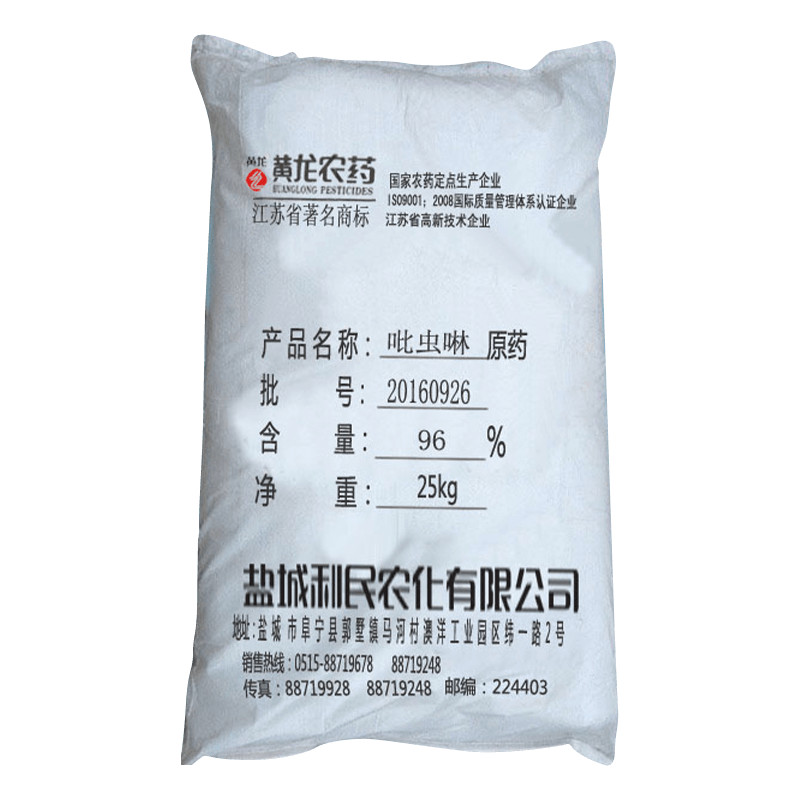 Imidacloprid 96–98% TC Insecticide TechnicalCrystalline neonicotinoid technical with low water solubility, suited to suspension concentrates, water-dispersible granules and seed-treatment flowables.View Product →
Pymetrozine, classified in IRAC 9B, works through a different route entirely: it disrupts feeding behaviour in aphids and planthoppers rather than acting as a conventional nerve poison. Flonicamid, in IRAC 29, targets chordotonal organs and is similarly selective toward sucking pests. Both are valuable precisely because they are not neonicotinoids, and both are technically awkward in their own ways — low water solubility, high melting points, and a strong preference for solid formulation routes.
The tetramic acid class, represented by spirotetramat in IRAC 23, inhibits acetyl-CoA carboxylase and shows two-way systemic movement within the plant, which is why it appears in programmes targeting hidden populations on new growth. As a technical it is a low-solubility solid, normally delivered into suspension concentrate formulations, and its stability in aqueous media is sensitive to pH and to storage temperature. Buyers who treat it as interchangeable with a neonicotinoid on the strength of a similar target spectrum usually discover the difference during accelerated storage testing.
 Spirotetramat Technical Concentrate for FormulationBidirectionally active tetramic acid technical supplied as a low-solubility solid for suspension concentrate development where storage stability matters.View Product →
Indoxacarb, an oxadiazine in IRAC 22A, is the standard example of a technical where the enantiomer specification does real commercial work. It is used mainly against lepidopteran larvae, formulated as suspension concentrates and emulsion concentrates, and its activity depends heavily on the ratio of the two enantiomers delivered in the drum.
Abamectin, a macrocyclic lactone in IRAC 6, occupies a different niche again and is commonly paired with a second active to widen the spectrum or to manage resistance. Methomyl, a carbamate in IRAC 1A, remains commercially important in some markets but carries a high acute toxicity classification, which drives handling requirements, transport documentation and, in a growing number of jurisdictions, registration restrictions. Whether a technical is technically purchasable and commercially registrable are two separate questions, and the second one should be answered before the first purchase order is raised.
| Class | IRAC group | Representative technicals | Formulation fit |
|---|---|---|---|
| Neonicotinoids | 4A | Imidacloprid, acetamiprid, dinotefuran | Suspension concentrate, water-dispersible granule, seed treatment flowable |
| Oxadiazines | 22A | Indoxacarb | Suspension concentrate, emulsion concentrate |
| Pyridine carboxamides | 29 | Flonicamid | Suspension concentrate, water-dispersible granule |
| Triazinones | 9B | Pymetrozine | Water-dispersible granule, suspension concentrate |
| Tetramic acids | 23 | Spirotetramat | Suspension concentrate, oil dispersion |
| Avermectins | 6 | Abamectin | Emulsion concentrate, suspension concentrate |
| Carbamates | 1A | Methomyl | Wettable powder, emulsion concentrate, restricted in some markets |
The single most expensive mistake in technical sourcing is choosing a material that is chemically correct and physically wrong for the line it will run on. The formulation route narrows the acceptable technical specification far more than the assay does.
An emulsion concentrate requires the active to dissolve in a water-immiscible solvent system, which in turn constrains the technical's solubility, the polarity of the solvent blend, and the flash point of the finished product for transport classification. A technical that assays well but dissolves slowly or incompletely will leave undissolved crystals that appear as sediment in the drum and as nozzle blockage in the field. Solubility testing in the actual proposed solvent blend, at the actual proposed concentration, at both 20 degrees and 0 degrees Celsius, is a five-gram experiment that prevents a five-tonne problem.
Suspension concentrates demand low water solubility, because a soluble technical will simply dissolve into the continuous phase and never form a stable dispersion. Beyond that, the technical must mill to a stable particle size, must not undergo Ostwald ripening or crystal growth during storage, and must tolerate the pH of the formulation. Pymetrozine is a good illustration: its low solubility makes it a natural suspension concentrate or granule candidate, but its high melting point and crystal habit mean that milling and wetting agent selection have to be tuned to the specific source of technical, not to the generic active.
 Pymetrozine 96–98% Technical ConcentrateLow-solubility pyridine technical for suspension concentrate or granule routes, with milling and wetting selection sensitive to crystal habit.View Product →
Two milled slurries at the same assay, made from two sources of technical, can behave completely differently after fourteen days at 54 degrees Celsius. One holds its particle size distribution; the other shows a shoulder in the distribution that indicates crystal growth. When that happens, the technical is usually the variable, not the dispersant.
Granule and powder routes place a premium on the technical's physical form: flowability, dustiness, wettability after granulation, and the absence of caking under load. Moisture content and particle hardness matter more here than in any other route. A technical that has been dried aggressively to reach a low moisture figure may become hard and difficult to granulate; one that has been dried gently may cake in the bag.
Seed treatment flowables tolerate higher active loadings but require very tight control of particle size and of impurities that could affect germination testing. Microencapsulation demands a technical that is essentially insoluble in both the aqueous and the oil phase, and free of impurities that interfere with interfacial polymerisation. In both cases, the qualification of a technical source is inseparable from the qualification of the formulation process.
Thermal and hydrolytic stability cut across all routes. A two-week exposure at 54 degrees Celsius is the standard screening condition, and it will surface problems that a room-temperature assay never will: pH drift, assay loss, viscosity increase, phase separation. Insist on stability data generated with your formulation, not only with the supplier's reference formulation.
Regulatory equivalence is where technical sourcing stops being a purchasing decision and becomes a corporate risk. Most registration systems require the applicant to describe the technical source, the manufacturing route in outline, and the impurity profile, including any impurity of toxicological concern above a defined threshold. Change the source, and in many jurisdictions you have changed the product, even if the active ingredient is chemically identical.
The mechanics vary. In the European Union, technical equivalence is assessed formally, and a different manufacturing route or a different impurity profile can lead to a non-equivalence finding that requires new toxicology. Under FAO and WHO specifications, the active must meet a published specification supported by CIPAC analytical methods, and the applicant must demonstrate that its material complies. In national registration systems across Asia, Latin America and Africa, requirements range from a full five-batch analysis to a certificate and a sample, but the direction of travel is uniform: more impurity data, more route transparency, more traceability.
Five-batch analysis is the practical instrument here. The applicant submits analytical data from five production batches, showing assay, impurities and the consistency of the profile. The value of the exercise is not the paperwork; it is the evidence that the route is under control. A supplier whose five batches scatter across three impurity patterns does not have a stable process, and no amount of certificate formatting will fix that.
Route transparency also has a commercial dimension. Technicals whose synthesis is integrated upstream — where the key intermediate is made by the same producer rather than bought on the open market — generally show tighter impurity control, because the intermediate specification is under the same quality system as the final active. This is one reason to ask where the intermediate comes from, not just where the technical is finished and packed. A producer that manufactures triazole intermediates, pinacolone derivatives or fluorinated benzophenone building blocks in-house can hold a specification that a pure assembler cannot.
Change control is the clause that protects you. A supplier that can alter the synthesis route, the solvent system or the purification step without notifying the customer has the ability to invalidate your registration silently. Write the notification requirement into the supply agreement, define what constitutes a change, and require a sample and a full analytical package before the first commercial batch under the new route is shipped.
Technical insecticides move as industrial chemicals, and the packaging reflects that. Solid technicals typically ship in 25 kg fibre drums or bags with a double inner liner, sometimes in 500 kg or 1000 kg bulk bags for high-volume formulators. Liquid technicals and technical concentrates move in 200 litre drums or intermediate bulk containers. The choice is not cosmetic: liner compatibility with the active and with residual solvent, drum integrity during sea freight, and the practical ability to reseal a part-used container all affect quality on arrival.
The documentation set should be treated as part of the product. A complete shipment carries a certificate of analysis for the batch, a safety data sheet in the required language and format, GHS classification and labelling, transport classification where applicable, and stability data or a shelf-life statement. For export markets, add the certificate of origin, the packing list, and any registration support documents the buyer needs to file locally.
Storage conditions deserve a line of their own. Many technicals are stable for two years in a cool, dry warehouse and considerably less in a hot one. If your climate or your warehouse does not match the label conditions, the shelf life on the certificate is a number about somebody else's building. Buying forward to capture a seasonal price advantage only works if the material can actually be stored without drifting out of specification.
The technical insecticide market contains three kinds of seller, and they carry different risks. There are integrated manufacturers that run synthesis, purification and finishing under one quality system. There are formulators that also trade technicals they do not make. And there are pure traders who buy, blend, repack and relabel. Each can be a legitimate supplier, but the due diligence is not the same, and the price difference between them is usually a fair reflection of who carries the quality risk.
For an integrated manufacturer, the questions are about capacity, consistency and change control. Can the plant show five-batch data from the last two years? Is the intermediate made in-house or bought? Which site makes which step, and does a transfer between sites trigger a customer notification? What is the actual batch-to-batch assay spread, not the specification limit? A supplier with two production bases — one for synthesis, one for formulation — can offer continuity advantages, but only if the quality systems at both sites are auditable to the same standard.
For traders and repackers, the questions shift to traceability. Whose technical is in the drum, from which plant, and can that be evidenced batch by batch? A repacker that cannot answer this is not selling you a technical; it is selling you an average of several technicals, and your registration will not survive contact with an inspector.
Background checks are inexpensive compared with a failed batch. Reviewing a manufacturer's corporate and site information, its certifications, its patent position and its stated quality infrastructure takes an afternoon and eliminates most of the wrong shortlist. The company background of a Chinese technical producer, for example, should tell you the founding date, the number of production sites, whether the business spans intermediates through to formulations, and what external recognition exists — because those details determine whether the supplier can hold a specification over years rather than shipments.
Technical insecticide prices are driven by the cost of the key intermediate, the yield of the final step, energy and effluent treatment, purification intensity, packaging and freight. When a quotation is materially below the market, one of those inputs has been economised, and the buyer's job is to find out which. Usually it is purification: a shorter recrystallisation, a higher residual solvent limit, a wider impurity band that still meets a loose specification.
The arithmetic of buying on assay alone is instructive. Suppose your formulation requires a fixed active content per batch. A technical at 95% instead of 97% means roughly 2% more material per batch, which at a 200-gram-per-litre active loading is a small but real cost. The larger cost appears elsewhere: extra inert load in a suspension concentrate affects viscosity and suspension stability; extra impurity load affects storage behaviour; extra moisture affects granule integrity. A three-percent saving on raw material that generates a one-percent rejection rate on finished goods is not a saving.
Seasonality and forward buying are the second pricing trap. Demand for certain actives clusters before planting seasons, and freight rates and container availability move independently of the chemistry. Buying forward to lock in a price only makes sense if the technical will still be inside specification when it comes out of the warehouse, and if the registration allows for the storage interval. Where the material has a moisture sensitivity or a tendency to cake, long inventory is a quality decision disguised as a financial one.
how technical actives move from raw material to finished crop protection productsCurrency and payment terms matter as well, but they are visible risks that procurement teams already manage. The invisible risk is specification drift across a long supply relationship: the first three lots are excellent, the fourth is thin. A schedule of regular independent testing, with retained samples from every receipt, is the cheapest insurance available in this category.
Most problems in this category repeat themselves across companies and across continents. The list below is drawn from the patterns that show up again and again when a formulation fails and the investigation reaches back into the raw material.
Each of these is cheap to prevent at the specification stage and expensive to correct after a batch has been manufactured, packed and shipped. The pattern behind all of them is the same: treating a technical insecticide as a commodity defined by one number, rather than as a manufactured chemical defined by a process.
A workable programme is not complicated, and it does not require a large analytical department. It requires a written specification, a testing habit, and a supplier relationship that survives being asked difficult questions.
Two habits make the difference between a programme that works and one that exists on paper. The first is keeping a retained sample of every batch received, stored under the conditions stated on the label, labelled with the batch number and the date of receipt. When a formulation fails eighteen months later, that sample is the only way to establish whether the technical or the process changed. The second is treating the supplier's quality system as a subject of ongoing interest rather than a one-time audit. Route changes, site transfers, capacity expansions and ownership changes all reach your drum eventually; a supplier that tells you before you find out is worth a price premium.
The commercial logic is straightforward. Insecticide technicals are the raw material of every formulated insecticide your business sells, and their specification determines your registration, your process yield and your field performance. Paying attention to five things — assay with a mass balance, impurity and isomer profile, physical form, formulation compatibility, and documentation that will hold up later — costs a few days at the start of a relationship. Skipping them costs a batch, a registration file, or a season.
Contact info.
 Tel: +0086(515)88719699
 Phone: +86-18261226148
 E-mail: limin@chinapesticides.com
 Add: 21F & 22F, Jinhang Fortune Building, No. 988 Luming Road, Yancheng City, Jiangsu Province, China
Im.&Ex. Departemt
Tel:+0086(515)88356821
E-mail:
lany@chinapesticides.comFollow Us
Copyright © Yancheng Limin Chemical Co., Ltd. All Rights
Reserved
 Wholesale Agrochemical Manufacturers