
 EN
 English
 中文简体
Home / News / Industry News / Fungicide Formulation: Types, Technical Specs, Quality Control and Sourcing
Industry News
Content
A warehouse manager in Rotterdam opens a pallet of 250 g/L tebuconazole EC that left the plant in good condition and finds a soft but stubborn sediment in the bottom of every bottle. The COA says the batch is on specification. The technical material assayed at 97.2%. Nothing in the paperwork explains the problem, because the problem is not in the active ingredient. It is in the formulation.
That is the short answer to a question buyers ask constantly: why do two products with the same active, the same concentration and the same label claim behave so differently in the drum, in the tank and on the leaf? The active is only one input. The dispersant system, the wetting agent, the thickener, the antifreeze, the buffer, the milling route and the granulation method all decide whether the product stays homogeneous for two years or separates in the first hot season.
Fungicide formulation is the engineering step that converts a technical active ingredient into something a grower can measure accurately, mix without lumps, spray through a 110-02 nozzle, cling to a waxy leaf, survive a rain event and store in a shed that reaches 45 °C in July. Get it right and the active performs exactly as the efficacy trial promised. Get it wrong and the best technical material in the world delivers a mediocre result and a customer complaint.
What follows works through the decisions in the order a formulator actually faces them: the technical material specification, the choice between SC, EC, WP, WDG and EW systems, the complications of putting two actives in one bottle, adjuvant and spray-water interactions, the quality control tests that prove stability, and the sourcing questions that determine whether batch forty behaves like batch one.
A fungicide formulation is a mixture of an active ingredient with carriers, surfactants and functional additives, engineered to deliver a defined dose of active to a defined target in a reproducible way. The technical material is fungicidally active but practically unusable on its own: it does not disperse in water, it does not stick to foliage, it settles out of suspension within minutes, and in some cases it is unstable in the presence of water, sunlight or metal ions.
The formulation solves each of those problems at once, and the constraints pull against each other. High active loading improves logistics and reduces packaging cost but raises viscosity, increases the risk of crystal growth and narrows the choice of dispersants. A solvent-based system gives excellent coverage and rapid uptake but increases phytotoxicity risk on tender foliage and introduces flash-point and packaging constraints. A water-based system is gentler and easier to transport but demands a robust preservative and antifreeze package.
This is why the same active commonly appears in several formulation types. A triazole might be sold as an emulsifiable concentrate for mature cereal canopies, as a suspension concentrate for fruit and vegetables, and as a flowable concentrate for seed treatment. The chemistry is identical. The delivery problem is not.
Formulation development tends to follow the same sequence regardless of the active involved. Skipping a step is the usual reason a project fails late in the process, when tooling is already committed.
The starting point is the effective dose per hectare, not the concentration in the bottle. A product carrying 250 g/L at a 0.8 L/ha use rate delivers 200 g ai/ha; the same active at 430 g/L and 0.5 L/ha delivers 215 g ai/ha. Loading, dose and spray volume have to be solved together, because they set the concentration of active in the spray tank and therefore the particle or droplet population that reaches the leaf. Mode of action matters here as well: protectant actives need uniform coverage of the leaf surface before infection, while systemic actives with curative activity can tolerate slightly coarser deposition because the active redistributes inside the tissue.
The active's solubility in water and in organic solvents, its melting point, its hydrolytic stability and its crystal habit determine which formulation types are even possible. Solids that are insoluble in water and stable at neutral pH are natural candidates for suspension concentrates, wettable powders and water-dispersible granules. Solids that are soluble in aromatic solvents can go into emulsifiable concentrates or emulsions in water. Liquids and low-melting solids frequently end up as emulsions in water, where the active sits in a solvent droplet rather than a crystal lattice.
Surfactants do three jobs at once: they wet the solid or emulsify the liquid during dilution, they keep particles or droplets apart long enough for the spray to reach the target, and they modify the contact angle of the deposit on the leaf. An anionic dispersant such as a naphthalene sulfonate condensate provides charge stabilisation in an SC; a nonionic wetting agent lowers surface tension and improves spreading; an ethoxylated tristyrylphenol phosphate ester can do both. The balance between them is one of the most closely guarded parts of any commercial formulation, because a small change in the ratio shows up as a large change in suspensibility after accelerated storage.
A suspension concentrate is made by bead milling a pre-mix to a median particle size of roughly 1.5 to 3 µm. A wettable powder is jet milled to a similar or slightly coarser range. A water-dispersible granule is built from the same powder blend and then agglomerated by extrusion or fluid-bed granulation. Each route brings its own failure modes: bead mill contamination and overheating, jet mill attrition, granule friability. The specification and the control method need to be written around the route that will actually run in the plant, not the route used for the laboratory sample.
No formulation type is intrinsically better. Each is a trade between loading, crop safety, stability and cost, and the right answer depends on the active and the market.
| Type | Typical active loading | Carrier | Main strength | Main risk |
|---|---|---|---|---|
| Suspension concentrate (SC) | 20-50% w/w | Water | No solvent, low phytotoxicity, easy measuring, good tank-mix behaviour | Settling and crystal growth in storage; viscosity drift |
| Emulsifiable concentrate (EC) | 20-50% w/w or g/L | Aromatic solvent | High loading, excellent leaf wetting, simple manufacture | Solvent stress on young tissue; flash point and packaging constraints |
| Wettable powder (WP) | 25-80% w/w | Kaolin, diatomite, silica | Mature technology, high loading, low cost | Dust during measuring; visible residue; poor flow |
| Water-dispersible granule (WDG) | 20-75% w/w | Same fillers plus binder | Dust-free, easy measuring, compact packaging | Attrition and caking if binder system is weak |
| Emulsion in water (EW) | 10-40% w/w | Solvent plus water | Lower solvent load than EC, gentler on crops | Creaming, Ostwald ripening, higher emulsifier demand |
| Capsule suspension (CS) | 10-40% w/w | Water plus polymer shell | Controlled release, reduced acute toxicity | Complex process control, batch-to-batch shell variation |
| Flowable concentrate for seed treatment (FS) | 5-30% w/w | Water plus film former | Adhesion to seed, low dust | Film cracking, poor flowability of treated seed |
The practical consequence is that a buyer comparing quotations for the same active at the same concentration may be comparing fundamentally different products. A 20% SC and a 20% EW of the same triazole will differ in rainfastness, in crop safety at high temperature, in tank-mix compatibility with a foliar fertiliser, and in what happens when the drum sits in a container yard in August.
Formulation problems are frequently traced back to a technical material that met its assay specification and nothing else. Assay measures how much active is present. It says nothing about the impurities, the water content, the crystal form or the particle size distribution, and each of those can destroy an otherwise sound formulation.
| Parameter | Typical limit | Why it matters downstream |
|---|---|---|
| Assay (purity) | 95-98% depending on active | Sets the active load calculation and the inert fraction that must be accommodated |
| Water content | Usually 0.5% or lower | Free water promotes hydrolysis and caking; it also disturbs the dispersant balance in an SC |
| Acidity | Often 0.3% or lower as sulfuric acid | Acidic impurities attack milling equipment and shift the pH of the finished suspension |
| Acetone insolubles | Typically 0.3% or lower | Inorganic and polymeric residues block filters during bead milling and cause nozzle wear |
| Polymorphic form | Specified where relevant | One polymorph may convert to another in suspension, changing solubility, viscosity and biological performance |
| Particle size of technical | Often below 100 µm before milling | Coarse or agglomerated material lengthens milling time and skews the particle size distribution |
Polymorphism deserves particular attention with triazoles and strobilurins. Two crystal forms of the same molecule can have different melting points, different solubility and different milling behaviour. A supplier change that moves from one form to another will not show up in the assay, but it will show up in an accelerated storage test three months later when the suspension thickens or a hard cake forms.
Buyers should ask for the full specification, not just the assay, and should ask which parameters are controlled batch to batch versus which are merely reported. A specification with twelve parameters where six are actually tested is a marketing document, not a quality system.
The suspension concentrate is the workhorse of modern fungicide formulation, and it is also the most demanding to keep stable. A typical composition combines the active with a dispersant system, a wetting agent, an antifreeze, a thickener, a preservative, an antifoam and a pH buffer.
Particle size is the single most consequential number in the whole design. Halving the median particle size from 10 µm to 2 µm increases the number of particles per unit mass by roughly a factor of 125. That means far more particles covering the same leaf area, better adhesion, faster dissolution for systemic uptake and less nozzle blockage risk from oversized particles. It also means far more surface energy in the system, which is exactly why the dispersant package has to be right. Under-dispersed fine particles flocculate, and flocculated particles settle into a cake that will not redisperse.
Ostwald ripening is the long-term enemy. Smaller particles dissolve and redeposit onto larger ones, so the distribution gradually coarsens and the suspension loses suspensibility even though the active content has not changed. Temperature cycling accelerates the process. A well-designed SC therefore includes a ripening inhibitor, careful control of the upper end of the particle size distribution, and a milling target that leaves enough fines to maintain coverage while avoiding an excessively broad distribution.
Co-formulated suspension concentrates such as a prothioconazole and pyraclostrobin 20 + 20 SC illustrate the balancing act. Two crystalline actives with different surface chemistry have to be milled into one continuous phase without one of them aggregating preferentially. In practice the two are often pre-milled separately and blended, or milled together with a dispersant system selected to work for both surfaces. The finished product still needs to meet the same suspensibility, wet sieve residue and persistent foam targets as a single-active SC.
Wettable powders remain common in markets where cost per hectare dominates and where a little visible residue on the fruit is tolerated. The active is blended with a mineral filler, a dispersant and a wetting agent, then jet milled. Suspensibility above 70-80% and a wet sieve residue below 2% are the usual targets.
The weaknesses are physical rather than chemical. Powders generate dust during measuring, which is an operator exposure issue as well as a loss of product. They can cake in humid storage. Their bulk density makes freight expensive. And because the powder is measured by volume in the field, dosing accuracy depends on the grower rather than the package.
Water-dispersible granules solve most of those problems by taking the same milled blend and agglomerating it into granules that disperse back into primary particles in the spray tank. The critical properties become dispersibility, wetting time, attrition resistance and resistance to caking under load. Attrition resistance is tested by tumbling the granules with steel balls and measuring the fines generated; a granule that crumbles in the bag will leave dust at the bottom of the drum and a variable dose in the tank.
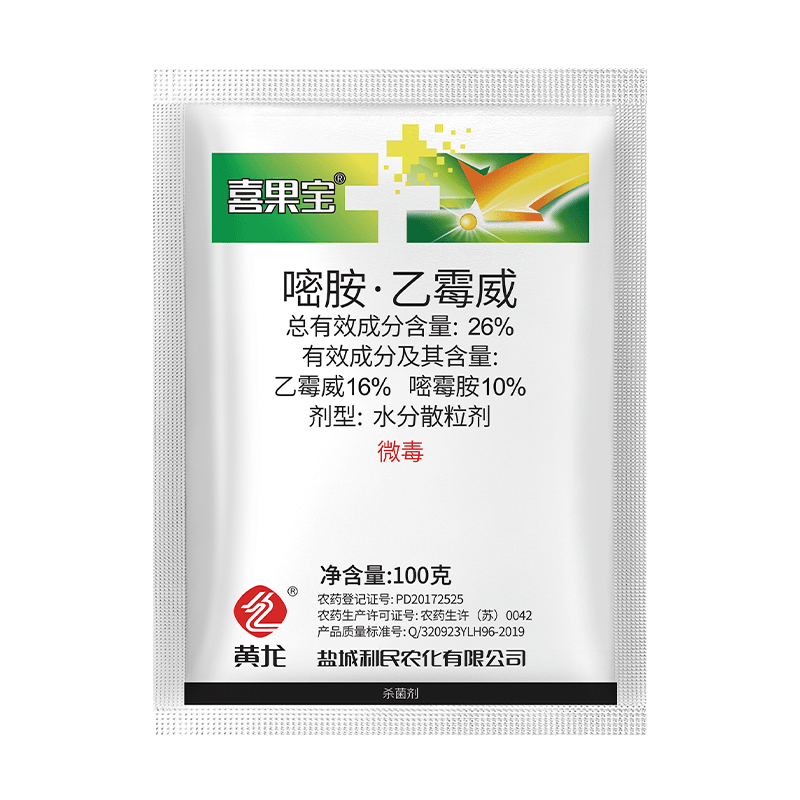 Pyrimethanil and Diethofencarb Water-Dispersible Granule FungicideA 10% pyrimethanil and 16% diethofencarb WDG for cucumber gray mold, with rapid water disintegration and relevance to granule dispersion and storage.View Product →
Granule formulations also allow higher active loading than most liquid systems. A 75% WDG carries three times the active per kilogram of a 25% SC, which matters for container utilisation and for distributor shelf space in markets where the selling season is short and inventory turns slowly. The trade-off is that granule quality is highly process-dependent: binder selection, moisture control during granulation and drying profile all influence whether the product still disperses cleanly eighteen months after manufacture.
An emulsifiable concentrate dissolves the active in an aromatic solvent with an emulsifier blend. On dilution the concentrate disperses into fine droplets, typically in the 1-5 µm range, which spread readily on waxy leaf surfaces. The system is simple to manufacture and gives excellent coverage, which is why it remains popular for cereals and for actives that are readily soluble in hydrocarbon solvents.
The drawbacks are well documented. Aromatic solvents can soften the cuticle of young leaves and produce marginal necrosis, particularly when application coincides with heat stress or when the spray overlaps onto sensitive neighbouring crops. The formulation is flammable, which affects transport classification and warehouse requirements. Packaging must resist solvent permeation, which rules out standard monolayer HDPE in favour of fluorinated or multilayer coextruded bottles.
An emulsion in water reduces the solvent load considerably. The active is dissolved in a smaller quantity of solvent and that solution is emulsified into a continuous water phase, so the finished product carries perhaps 5-20% solvent instead of 40-60%. Crop safety improves, transport becomes easier and the product presents as a conventional liquid. The cost is formulation complexity: the emulsifier system must produce a stable emulsion in the drum and in the tank, withstand hard water at 342 mg/L as calcium carbonate, and resist creaming over two years of storage.
 Tebuconazole and Prochloraz Emulsion in Water FungicideA 15% tebuconazole and 30% prochloraz EW for wheat Fusarium head blight, offering a lower-solvent emulsion format relevant to crop safety.View Product →
Emulsions are particularly suited to actives that are liquid or low-melting, and to combinations where one partner benefits from solvent delivery. A tebuconazole and prochloraz 15 + 30 EW is a representative case: both actives are delivered as an oil phase dispersed in water, giving high combined loading with a solvent burden that is meaningfully lower than the equivalent EC, which matters where the product is positioned on young or tender tissue.
Mixtures dominate modern fungicide formulation because they manage resistance, broaden the spectrum and reduce application costs. From a formulation standpoint, however, a mixture doubles the number of interactions that can go wrong.
Two actives may be chemically compatible and physically incompatible. If one is a soft, waxy solid and the other a brittle crystal, milling them together can produce a distribution where the soft particles smear across the mill and the hard particles fracture unevenly. If the two have opposite surface charge, the dispersant that stabilises one will strip from the surface of the other and leave it flocculating.
The label ratio is a biological decision, but the plant has to hit it batch after batch. A 20 + 20 formulation requires analytical methods that quantify both actives independently in the presence of each other and in the presence of the dispersant matrix. HPLC methods with a single wavelength often fail here; the quality control laboratory needs a validated method for each component and a specification for the ratio, not just the total active content.
One partner may be sensitive to pH while the other needs a mildly acidic environment for stability. The buffer system has to satisfy both, and the storage test has to be run on the finished mixture rather than on each active separately. A strobilurin that is perfectly stable at pH 6 in isolation can degrade measurably at pH 8, and the presence of a second active does not change that chemistry, only the temptation to overlook it.
There is also a commercial dimension. Co-formulated products are harder to reverse-engineer and harder to substitute, so they tend to hold their price position better than single-active commodities. That is a legitimate reason to develop them, but only after the physical and analytical problems above have been solved.
A formulation that performs perfectly in the laboratory can fail in a spray tank filled with cold, hard, alkaline water and mixed with three other products. Three variables dominate the gap between factory and field.
Adjuvant choice is part of formulation performance rather than a separate topic. An oil-based adjuvant improves spreading and rainfastness on waxy cuticles; a nonionic surfactant improves retention on difficult surfaces; a drift control agent increases droplet size and can reduce coverage if overused. The formulation chemist cannot control the adjuvant, but can and should provide a compatibility statement and a recommended tank-mix order that holds across the water qualities in the target market.
Physical compatibility should be verified with a jar test at the intended dilution and water hardness before any large-scale mixing. Chemical compatibility, meaning no degradation of either partner, requires analytical work. Most tank-mix failures reported in the field are physical: fine floc, oil film or a precipitate that blocks filters within an hour.
Formulation quality is demonstrated by tests that attempt to compress two years of storage into a few weeks. The FAO and WHO specifications, supported by CIPAC methods, set the framework most manufacturers work to even when registering nationally.
Two practical points are often missed. First, the accelerated storage sample should be tested in the commercial package, not a glass jar, because permeation and headspace effects are part of the real problem. Second, the specification must include the storage result, not just the fresh result. A fresh batch that meets suspensibility at 95% is not compliant if it falls to 60% after fourteen days at 54 °C.
For a distributor or a formulator buying technical material, the most expensive problem is not a bad batch. It is a good batch that is not the same as the last one. Crystal form changes, impurity profile shifts and dispersant supplier changes all produce products that pass release testing and fail in the field.
The supplier questions that actually predict trouble are specific. Which parameters are tested on every batch, and which are tested periodically? What is the retained sample policy and for how long? Are the accelerated storage data generated on the same manufacturing route as the commercial product? Has the source of technical material changed since the registration dossier was filed, and if so was the change notified?
Production depth matters here. A manufacturer that controls intermediates, technical material and formulation in one chain has more visibility into the variables that affect crystal form and impurity profile than a company that buys technical material on the spot market and blends it. A broader view of how raw actives move into finished crop protection products is useful context when assessing that depth.
Logistics and documentation belong in the same evaluation. Water-based formulations are generally easier to ship than solvent-based ones, but they still need protection from freezing in unheated containers, and the preservative system has to survive the temperature profile of the route. Buyers should confirm the packaging specification, the shelf life stated on the label versus the shelf life demonstrated in testing, and whether registration support documents, including the physico-chemical data package, are available for the target market.
Most field failures fall into a small number of categories, and each has a characteristic signature. Reading the symptom correctly saves weeks of trial work.
| Symptom | Likely cause | Practical fix |
|---|---|---|
| Hard sediment that will not shake up | Flocculation or Ostwald ripening; dispersant desorption over storage | Re-balance dispersant and wetting agent; tighten upper particle size; add ripening inhibitor |
| Viscosity rises over time | Thickener hydration drift; pH shift; crystal growth into a network | Re-check thickener grade and dispersion method; buffer the pH; re-test at 54 °C |
| Persistent foam in the tank | Excess high-foaming surfactant; antifoam insufficient after storage | Switch to a lower-foam wetting system; confirm antifoam survives accelerated storage |
| Creaming or oil film on dilution | Emulsifier HLB mismatch or insufficient emulsifier in an EW or EC | Re-tune the emulsifier blend against the actual solvent; test in hard water |
| Phytotoxicity on young leaves | Solvent load too high for the crop stage or temperature | Move to a water-based system or reduce solvent fraction; test at high temperature |
| Reduced efficacy despite correct dose | Degradation in storage, poor rainfastness, or antagonistic tank mix | Assay stored samples; add a retained-activity check; review tank-mix order |
| Dust and fines in a granule drum | Weak binder system, granule attrition in transit | Re-formulate the binder; specify attrition resistance on the release sheet |
In practice, a single fault often presents as two symptoms. A suspension that has coarsened through ripening will usually also show a drop in suspensibility and a rise in wet sieve residue. Tracking the three together makes the diagnosis much faster than treating each result as an isolated failure.
Before committing to a formulation for registration or to a supplier for a season's volume, the following checks cover most of the risk that paperwork alone will not reveal.
None of these steps is exotic. They are simply the difference between buying a specification and buying a product that will behave the same way in the third season as it did in the first.
Fungicide formulation is usually discussed as a technical specialty, but the decisions it involves are commercial as much as chemical. The choice between an SC and an EW changes the crop safety profile, the transport classification, the packaging cost and the tank-mix advice on the label. The choice of dispersant changes whether the drum that arrives in June still pours in September. The choice of technical supplier changes everything downstream, quietly, in ways that assay results will never show.
The reliable approach is to work backwards from the field problem. Decide the dose and the spray volume, decide what the crop will tolerate at the temperatures it will actually experience, decide how the product will be stored and shipped, and only then settle on the formulation type and the specification that supports it. A product built that way tends to pass its accelerated storage test on the first attempt, because the design was never aimed at the laboratory in the first place.
Contact info.
 Tel: +0086(515)88719699
 Phone: +86-18261226148
 E-mail: limin@chinapesticides.com
 Add: 21F & 22F, Jinhang Fortune Building, No. 988 Luming Road, Yancheng City, Jiangsu Province, China
Im.&Ex. Departemt
Tel:+0086(515)88356821
E-mail:
lany@chinapesticides.comFollow Us
Copyright © Yancheng Limin Chemical Co., Ltd. All Rights
Reserved
 Wholesale Agrochemical Manufacturers